Excepts from the book “Evangelical Theology” by Uche Anizor, Rob Price, Hank Voss

It is not unique doctrines, but unique doctrinal emphases, that mark evangelical theology. Bible, cross, conversion, and mission are the emphases that animate evangelical theological reflection and often delimit it from other theological traditions.
If the work of Jesus Christ on the cross and the work of the Holy Spirit in conversion are the center of evangelical theology (Part 2), then the Bible and mission could be described as its origin and goal.
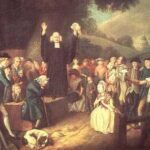
With the great revivals of the eighteenth century, the evangelical movement finally emerges in its distinctive identity. These revivals were led by figures like Jonathan Edwards (1703–1758), George Whitefield (1714–1770), John Wesley (1703–1791), and Charles Wesley (1707–1788).7 Although the so-called Great Awakening was focused around events in New England in 1739–42, it was part of “an international series of revivals that stretched from Germany to Nova Scotia to the Caribbean,” and from the 1730s to the 1780s.8 Central to these revivals was the preaching of the “new birth.”
For example, John Wesley, over the course of his long ministry, traveled an estimated 250,000 miles and preached some forty thousand sermons.9 Huge crowds gathered in the open air to hear the gospel. A flood of publishing documented and furthered the revivals’ reach: pamphlets, newspaper stories, evangelical magazines, sermon collections, hymnals, and conversion narratives.10 Evangelicalism thus began as an international, interdenominational movement of revival, unified around a core set of theological emphases.
From Awakening to Missionaries
It was in the nineteenth century that the evangelical movement extended its reach across the globe. It did so as the expansionist impulse of the evangelical revivals flowed into international missionary work. Evangelical commitment to mission includes not only personal evangelism and social activism. It also includes preaching the gospel where Christ is not known (Rom 15:20) and making disciples of all nations (Mt 28:19). This international dimension of evangelical zeal for mission began in earnest in the 1790s with the foundation of major missionary societies.
At the beginning of the century (1800), roughly 1 percent of Protestants globally lived outside Europe and North America. By the end of the century (1900), roughly 10 percent did.12 (Today roughly 80 percent or more do.13) Herculean efforts of Bible translation accompanied missionary endeavors. The century after 1815 saw a fivefold increase in the number of languages (estimated at 572) into which at least a portion of Scripture had been translated, mostly by Protestants.
Scripture
In order to explain how it is that the Bible is the word of God, evangelical theology emphasizes a series of attributes of the Bible: its inspiration, authority, and truthfulness.
Authority!!
Jesus himself constantly relies on the authority of Scripture. When tempted by Satan, Jesus does not appeal directly to the Father’s authority or to his own authority. He appeals to the authority of Scripture (Mt 4:1–11; Lk 4:1–13). Three times he responds to Satan, “It is written.” Again, when Jesus explains why he submits to arrest and crucifixion, he does not appeal directly to the Father’s authority or to his own authority. Jesus appeals to the authority of Scripture (Mt 26:47–56; Mk 14:43–50; cf. Lk 22:37). “Let the Scriptures be fulfilled” (Mk 14:49). Even before an angry mob in the temple, Jesus confidently relies on subtle implications of Old Testament and insists that “Scripture cannot be broken” (Jn 10:35). Jesus states categorically in the Sermon on the Mount: “Do not think that I have come to abolish the Law or the Prophets; I have not come to abolish them but to fulfill them. For truly, I say to you, until heaven and earth pass away, not an iota, not a dot, will pass from the Law until all is accomplished” (Mt 5:17–18). Jesus delighted in the authority of Scripture: “I delight to do your will, O my God; your law is within my heart” (Ps 40:8; cf. Heb 10:5–7). Jesus believes that Scripture bears God’s own authority. Evangelicals follow.